Picking the right playground equipment dimensions isn’t just about comparing product sizes. If you’re buying from overseas, you’ve got to think about the kids’ ages, how many will use it, fall zones, installation space, maintenance access, and what the actual site is like. A compact slide might fit into a school courtyard, sure—but the exit zone can still need a few clear metres. It’s the little details that get you.
Dr. Donna Thompson, a well-known playground safety researcher, put it like this: “Safety begins with thoughtful design, not with equipment added afterward.” And honestly, that point is still very practical. Dimensions affect supervision, movement, accessibility, and long-term risk management. They also affect shipping volume, container planning, assembly time, and whether replacement parts will fit later. Small mistakes? They get expensive fast.
This guide looks at ten important equipment dimensions for international buyers. We’ll cover platform height, deck width, slide length, swing spacing, guardrail height, and protective surfacing depth. We’ll also compare toddler and school-age layouts, because one standard rarely works well for every child. Some buyers get too focused on the equipment footprint. That assumption can backfire.
A playground needs breathing room.
In real life, drawings don’t always match the site. Sloped ground, drainage channels, tree roots, crowded entrances—they can all change the usable area. Buyers should ask established manufacturers for scaled plans, installation tolerances, material specs, and maintenance clearances. They should also double-check measurements with qualified local professionals before ordering. This article isn’t a substitute for site assessment or the safety guidance that applies to you. Think of it as a practical starting point. And here’s the honest limitation: dimensions alone can’t guarantee a successful playground. Context still decides a lot.
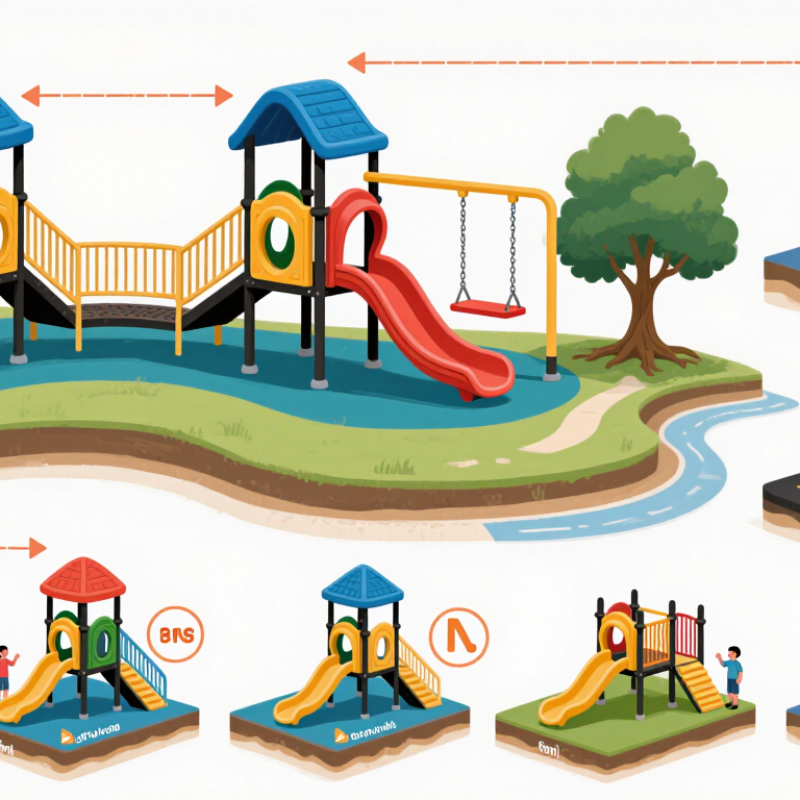
Playground equipment dimensions should match children’s age, body size, and movement ability. Toddlers need low, stable structures with platforms around 600–900 millimeters high. Ramps should feel gentle, with wide handrails and short travel distances. Small slides often work best at 900–1,200 millimeters. Sharp transitions can create fear, even when the equipment looks attractive.
Children aged five to eight usually manage platforms between 1,200 and 1,500 millimeters. Their climbing nets can be taller, but openings must remain small enough to reduce entrapment risks. A Swing Seat should leave enough space between neighboring seats and nearby posts. Busy school areas also need generous circulation paths. Crowded layouts become difficult to supervise.
Older children may use taller towers, longer slides, and challenging climbing walls. However, height alone does not prove good design. Water Park Playground Equipment needs non-slip surfaces, rounded edges, and drainage that prevents standing water. Wet play zones should separate running routes from waiting areas. Buyers should verify dimensions against local safety standards, installation conditions, and accessibility expectations.
Measurements on paper can mislead. A 1,500-millimeter platform may feel higher beside a narrow staircase. Site visits, sample assemblies, and installer feedback reveal problems early. I have found that manufacturers sometimes prioritize visual impact over comfortable reach distances. That choice deserves another review. Caregivers need clear sightlines, shaded waiting space, and enough room for assisted play.
Global buyers need dimensions that support safe movement, easy supervision, and practical shipping. The CPSC Public Playground Safety Handbook and ASTM F1487-21 emphasize accessible fall-height measurements, protective surfacing, and equipment-specific use zones. The following dimensions are practical starting points, not universal legal requirements.
A toddler platform usually works at 0.6–0.9 metres high. A slide should have a 0.6–1.2-metre deck and a 1.5–3-metre runout. A belt swing needs a 2.4–3.0-metre beam height, with roughly 0.6 metres between seats. A seesaw commonly measures 2.4–3.0 metres long and 0.5–0.7 metres wide. A climbing wall should stand 1.2–2.1 metres high, with handholds spaced about 0.3 metres apart. These figures need adjustment for age groups and local standards.
A spinner generally needs a 1.2–1.8-metre diameter and a clear 1.8-metre activity zone. A spring rider is often 0.7–1.0 metres long and 0.5–0.8 metres high. A crawl tunnel can measure 1.2–1.8 metres long, with an internal diameter near 0.6 metres. A transfer bridge should be 0.9–1.2 metres wide, while an accessible ramp benefits from a 1.2-metre clear width. EN 1176 requires careful evaluation of entrapment, impact areas, and critical fall height. CPSC guidance also links surfacing depth to fall exposure.
Safe playground sizing starts with the fall zone, not the platform height. In site reviews, I measure the highest accessible point, then map every possible landing area. A common planning benchmark is a clear zone extending about 1.8 metres around fixed equipment. Local standards may require more. Verify the critical fall height against the selected surfacing system, because grass and compacted soil usually provide limited impact protection.
Keep equipment separated.
Climbers, slides, and rotating units should not overlap their use zones. Leave extra space where children may run, turn, or fall sideways. Swing clearance needs special care. The front and rear zones often extend roughly twice the suspension height, but the exact distance depends on the swing design and governing standard. Side clearance also matters, especially beside fences, posts, benches, and circulation paths. A tape measure can reveal hazards that drawings hide.
For global buyers, request dimensions in metres and feet, plus a scaled layout showing fall zones. Check surfacing depth after installation, not only the listed depth. Drainage, settling, and edging can change usable clearance over time.
I would also question any plan that fits equipment tightly to save space. That choice may look efficient, yet it can create blind corners and crowded movement.
One imperfect detail remains common: installation teams sometimes measure from the equipment frame instead of the full use zone. A final on-site inspection should correct that mistake before children arrive.
Inclusive playground design begins with movement, not decoration. A firm, step-free route should connect entrances, play zones, and seating areas. For many projects, a clear path of at least 1.5 metres allows a wheelchair and another user to pass safely. A 1.5-metre turning circle also helps near transfer points, although local standards may require more space.
Ramps need consistent slopes, stable handrails, and edge protection where falls are possible. A 1:12 gradient is commonly referenced, but climate, terrain, and national rules can change the suitable design. Transfer platforms often work well around 450 to 500 millimetres high. They need a nearby stable surface, firm grips, and enough room for a child to shift safely. Soft, impact-absorbing surfacing should continue beneath and around equipment, without gaps that trap small wheels.
Inclusive play also needs ground-level activities. Add sensory panels, wide-access seats, low musical elements, and quiet corners with clear sightlines. When comparing Kids Playground Equipment Names, buyers should check access dimensions rather than relying on product labels. A wide deck can still fail if its entrance is narrow. That mistake happens.
Designers should review drainage, heat, maintenance, and seasonal surface changes before ordering equipment. Measurements taken only from drawings can mislead. A site visit often reveals hidden slopes, tree roots, or crowded circulation areas. Local accessibility professionals can verify final dimensions against current regulations.
Accessibility dimensions for inclusive playground design, shown in metres. These planning benchmarks are based on widely used accessibility and playground-safety guidance, including ADA accessibility criteria and public playground safety recommendations. Always confirm the final design against local regulations and standards.
The values represent minimum, maximum, or recommended planning dimensions as indicated. A 1.83 m use zone is commonly applied around many playground structures, while swing, slide, and equipment-specific clearance requirements may require additional space.
Regional standards can change how playground dimensions are selected, installed, and inspected. Global buyers should not treat one measurement chart as universally valid. A 1.5-meter platform may suit one market, yet require different guardrails, barriers, or fall protection elsewhere. Check the destination country’s current safety requirements before approving production drawings.
Measurement begins with the complete play area, not only the equipment footprint. Record platform heights, slide lengths, swing clearances, and impact-absorbing surface depths. Leave enough space for circulation and maintenance access. A tape measure is useful, but a scaled site plan reveals more.
Industrial Playground Equipment may need wider access routes for schools, parks, or supervised facilities. Metric and imperial conversions also create small errors that become expensive during installation.
Climate and user behavior deserve equal attention. Hot surfaces, heavy rain, frost, and strong sunlight can affect material performance and usable clearances. A coastal site may need different corrosion protection than an inland site. Accessibility rules can also influence ramp slopes, transfer spaces, and ground-level activities. These details are often missed in early quotations.
Honestly, no drawing is perfect at the first review. Recheck every dimension against the real site, local inspection practice, and expected age range. A two-centimeter mismatch can affect assembly, surfacing, or safe movement. Local professionals should confirm the final design before shipment.
Equipment size should follow materials, climate, and installation conditions, not catalog numbers alone. Heavy Duty Playground Equipment needs stronger frames, deeper foundations, and carefully tested impact surfaces.
CPSC Publication 325 reports more than 200,000 playground injuries treated annually in the United States. That figure makes fall-zone planning essential. CPSC guidance commonly recommends a minimum six-foot use zone around stationary equipment. Swing zones require greater clearance because movement extends forward and backward.
Climate changes the practical dimensions. The WMO State of the Global Climate 2023 report recorded 2023 as the warmest year measured, at about 1.45°C above the pre-industrial average. Dark metal surfaces can become extremely hot under direct sun. Specify heat-resistant coatings, shaded platforms, and drainage gaps for heavy rainfall. Coastal sites need corrosion-resistant fasteners and sealed joints. Cold regions may require extra foundation depth because frost can lift shallow footings. One standard rarely fits every site.
Tips: Measure the actual soil, slope, wind exposure, and maintenance access before selecting equipment. Leave room for delivery vehicles and future repairs. Follow ASTM F1487 or EN 1176 guidance, then confirm local requirements with a qualified installer. A common mistake is choosing taller slides for visual impact. Taller equipment increases fall height, surfacing needs, and inspection demands. Sometimes, smaller platforms serve more children safely. That deserves a second look.
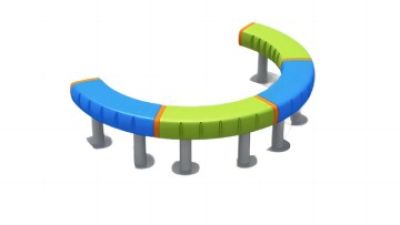
A single-plank bridge can transform an ordinary playground route into an exciting active-play challenge. Rather than simply walking from one platform to another, children must balance, coordinate their movements, and adjust their pace while crossing. This kind of dynamic play supports physical confidence and imaginative adventure without requiring complicated equipment. The World Health Organization recommends that children and adolescents aged 5–17 participate in at least 60 minutes of moderate-to-vigorous physical activity each day, making engaging playground features an important way to encourage movement.
Designed for repeated daily use, this bridge set combines a sturdy structure with an attractive, child-friendly appearance. Its durable construction is built to handle energetic play, while the single-plank layout offers an accessible challenge for different ability levels. Easy assembly helps playground operators install the equipment efficiently, and its simple design fits naturally into both new and upgraded play spaces. As children cross, pause, and try again, they develop balance, body control, and confidence through hands-on exploration.
Safety should remain central to every installation. The U.S. Consumer Product Safety Commission’s *Public Playground Safety Handbook* emphasizes appropriate protective surfacing, safe clearances, regular inspections, and proper maintenance around elevated play equipment. When installed on a suitable surface and checked routinely, a single-plank bridge can provide a dependable setting for active play, social interaction, and endless adventure that keeps children coming back.
A firm, step-free path of about 1.5 metres allows a wheelchair and another person to pass. Local rules may require more.
A 1.5-metre turning circle is useful near transfer areas. Confirm the required space with local accessibility professionals.
Ramps need steady slopes, firm handrails, and edge protection where falls could occur. A 1:12 gradient is commonly referenced.
Transfer platforms are often 450 to 500 millimetres high. Provide stable flooring, secure grips, and enough shifting space.
Include sensory panels, wide-access seats, low musical elements, and quiet corners. Keep sightlines clear for supervision.
Measure entrances, decks, platforms, clearances, and fall zones. A wide deck can still have a narrow entrance.
Drawings can hide slopes, tree roots, drainage problems, or crowded paths. A site visit often reveals these details.
Heat, rain, frost, and sunlight change surface performance and clearances. Use shade, drainage gaps, corrosion-resistant fittings, or deeper foundations when needed.
Leave circulation, maintenance, and impact-absorbing surface areas around equipment. Swings need extra space because their movement extends forward and backward.
No. Taller slides increase fall height, surfacing needs, and inspection demands. Smaller platforms may serve more children safely. Recheck the choice.
Choosing the right Playground Equipment Dimensions is essential for creating safe, engaging, and inclusive play spaces for children of different ages and abilities. This guide explains how equipment size and layout should match developmental needs, intended use, and available space. It reviews ten common playground types, including slides, swings, climbers, and balance elements, with practical recommendations for height, width, platform levels, and user capacity.
The article also highlights critical safety clearances, fall zones, equipment spacing, and accessibility dimensions for inclusive design. Global buyers will learn why regional standards, measurement systems, climate conditions, materials, and installation methods can influence final dimensions. By considering drainage, surface conditions, maintenance access, and local environmental factors during planning, buyers can develop playgrounds that are comfortable, durable, easy to maintain, and suitable for diverse communities while supporting safe and enjoyable play.